A few years ago I took my youngest, Auggie, to a playground nearby. I chased him around for a bit, and then watched as he attempted to play with the two or three other kids at the park. Inevitably, he ended up at the big twisty slide. First standing at the top and throwing a shoe down; his grinning face hanging over the edge as he watched his size 10 Nike flop end-over-end to the gravel below. Next, he took off his socks (the obvious next step after losing the shoes), and began to hike up the slide to the top.
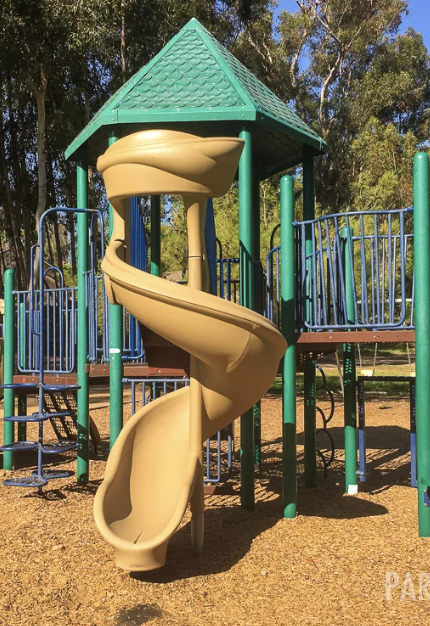
Another little boy noticed and took his shoes off as well, following closely behind Auggie to reach the summit. The two giggled and slid down to do it again. From across the playground I heard a fellow mom call out to her child, reprimanding him for his behavior. “Austin!” she shouted as she got closer, “SLIDES are for going DOWN only.” After her declaration she glanced, ever-so-slightly in my direction. Poor Austin gathered his shoes and began playing by himself in the tunnel.
And for a minute I felt the shame. What a horrible mother I was, with no boundaries for my child and all that exposure to peril. But then I stopped and thought about the facts:
1. There are three or four kids total on this playground (two of which were on the other side).
2. The info I’ve read on play in childhood has repeatedly emphasized how much kids need risky play. According to “The Anxious Generation” by Jonathan Haidt (more on this to come!), “…children need play that involves some risk to develop confidence and overcome their childhood anxieties.” In this situation, the worst case scenario is that Auggie falls off, a lesson any parent wants to avoid. But most likely he will test the edges, feeling the unease of being too close to falling. His body and muscles will adjust and he’ll gain the muscle memory and balance needed. But perhaps he gets run over by another child coming down? What a great social opportunity in how to look out for others, apologize, or navigate his own space safely.
3. Playgrounds today, including this particular one, have gotten increasingly ‘too safe’ hence- boring. Have you noticed why kids today are constantly pushing limits like these? Testing the edges of confidence and ability are cornerstones of a childhood equipping individuals socially and physically for adulthood.
In my position at an Elementary School, it is rare that I don’t make it outside for at least one or two grade level recesses. Partially because it’s an excellent time to connect with students socially (and recess tends to be frequent time to solve behavior issues), but I also enjoy working with the team that supervises daily. Over the last few years I have noticed many trends in play that are alarming and worth addressing head on. For example, when kids are bored, they push limits. Jumping off swings, running up slides, climbing too high, and running on equipment, are frequent concerns in the elementary playground liability world. But the irony is: by creating an “uber safe” playground, replete with smooth heavy plastic, low climbs, and the elimination of equipment like merry-go-rounds and tall jungle gyms, kids are more drawn than ever to create risk by using that ‘safe equipment’ in an increasingly unsafe way.

So what is the answer? Anyone with slight responsibility of liability concerns at schools will dodge this question instantly. The easy answer over the last thirty years has been to just avoid the risk. And with over 150 kids playing on the same areas, we simply don’t have the space and supervision staff to monitor and allow the risky play our kids desperately need for social and physical development.
If you haven’t read “The Anxious Generation” by Jonathan Haidt, it is an absolute must. I am currently only on page 93, but I would have recommended it after reading the intro. It’s terrifying what social media or a “Phone-Based Childhood” is doing to negatively contribute to youth mental health. Haidt describes how today’s parents are overprotecting in the real world (too safe playgrounds, not letting kids play outside enough unsupervised…) and under-protecting the virtual world. And truth be told, I say this from a parent’s perspective whom probably lets both of my kids have too much screen time on an average day. But it certainly gives me pause…
I’m left with a hope for a compromise. A playground that is safe, but allows for kids to test the edges and dabble in risk; gaining important social and physical wisdom researchers are finding many young adults to be lacking. I’m hopeful that we can continue to hire not just playground supervisors, but consultants. Monitoring safety, but helping kids to make good choices about how much risk is too much risk. As Haidt says in his book, “…they (kids) develop a broad set of competences, including the ability to judge risk for themselves, take appropriate action when faced with risks, and learn that when things go wrong, even if they get hurt, they can usually handle it without calling an adult.”
So did I really deserve that side-eye from another parent at the park?… Little did she know I was simply teaching a lesson on appropriate risk for my child’s physical and social development!
Take that, Austin’s mom.
*** The Anxious Generation by Jonathan Haidt is definitely a hot read right now. Everyone from Oprah to Charly’s high school is taking notice and rethinking the role that phones and social media play. When Charly (high school sophomore) heard her school was inspired to make a phone-free policy, she was understandably upset. Trying to be sympathetic I asked what she was worried about. She mentioned how she texts her friends before assemblies, asking if they are in the auditorium yet and where they are sitting. I thought for a minute, and then reminded her of the lessons she was missing by texting that; how to walk into a room and look for friends, how to wait by yourself for a minute until others arrive. These are things my generation just did, but we are realizing now how different the social world is for our children.
This is easily one of the most important books I’ll read all year.

(Click on picture for Amazon link)
 Teaching the Good Stuff