She was another mom in a group of friends my daughter hung out with when she was little. I really enjoyed her; great sense of humor, always willing to have the girls get together, and pleasant to chat with. But there was a hesitancy about this mom friend. A slight pause, a glancing shadow crossing her gaze every once in a while; a sense of guardedness I didn’t find in the other moms of the group.
One day in conversation about a sad event that happened to a mutual friend, this mom revealed that her sibling had died as a young adult in a tragic, sudden way. After expressing my immediate sympathy my next thought was… ‘ oh…she sees the thestrals.’
**Please allow a slight digression into my inner dorkdom about Harry Potter….**
According to Harry Potter creator, J.K. Rowling, thestrals are dark, skeletal winged horses who are invisible to everyone except for those who have witnessed death. And because Harry witnessed a tragic death at the end of the previous book, he is able to see these beasts easily, in comparison to his happy-go-lucky buddy Ron who cannot.

And although Harry Potter is a work of fiction (um, genius fiction), I do think this concept has some actual parallels to reality. Not so much as seeing creatures that others cannot, but in some people carrying a depth of life that not everyone does.
I’ve always prided my ability to ‘read’ a person. I feel like I’m a good judge of character, and normally enjoying seeing the best in everyone. And for certain people, like the mom friend above, I can sometimes sense when hearts are heavier than others. I see it while working with a sweet student who lost her dad recently. I see it in another student whose sister is going through treatment for a serious medical condition, and around a friend who repeatedly miscarried through her early marriage.
I also want to be clear and say that this ‘darkness’ (for lack of a better term) is not necessarily a bad thing. In fact, people I know who can indeed “see the thestrals” are some of the most grounded, even-tempered, caring people I know. Perhaps a dose of tragedy, although to be avoided at all costs, gives people a sense of importance and value in life. Last year in my blog I talked about a book by Susan Cain called Bittersweet. Cain talks about how it is in that darkness and sadness (sorrow she says) that our life becomes whole; rich and purposeful. Not suggesting that we all must witness trauma to be real people, but simply the idea of embracing all layers of emotion, rather than hiding from it- as we’re told by society to do.
And to some extent we’ve all experienced something that changed us. It doesn’t have to be a tragic death, but maybe a hard family situation or a toxic job environment.
Recently, my son had a friend over that he hadn’t seen in a year. Over that year, this little boy went through extreme family changes and loss. I watched his little hands as the boys took turns petting the cat and building with legos. My heart ached for this little guy and what he’s been through…
And although this sweet boy will forever now see the thestrals, he is also still whole. Perhaps where there is loss, other people will rise up to not fix but fill in the gaps; seeping through the edges in the form of aunts and uncles and cousins and dogs and love.
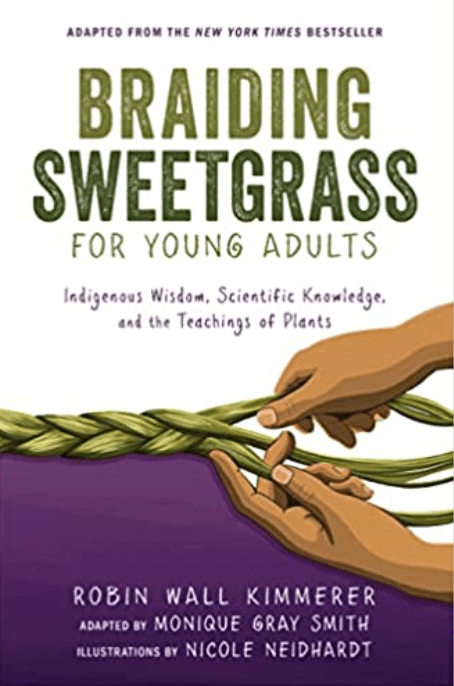
*** I just finished the young adult version of Braiding Sweetgrass by Robin Wall Kimmerer. It was paid for by a grant my dear friend Christie got for Shakopee Schools from the Mdewakanton Sioux Community. This book was the perfect way to start my summer. I sat on my deck while the summer breeze rippled the pages and read about indigenous practices involving plants and gratitude. It made me appreciate the gift of my vegetable garden, and breathe deeply as I walk through the nature trail in my neighborhood. Delightful.
 Teaching the Good Stuff